Monday, March 28, 2016

Trans-Spinal Direct Current Stimulation


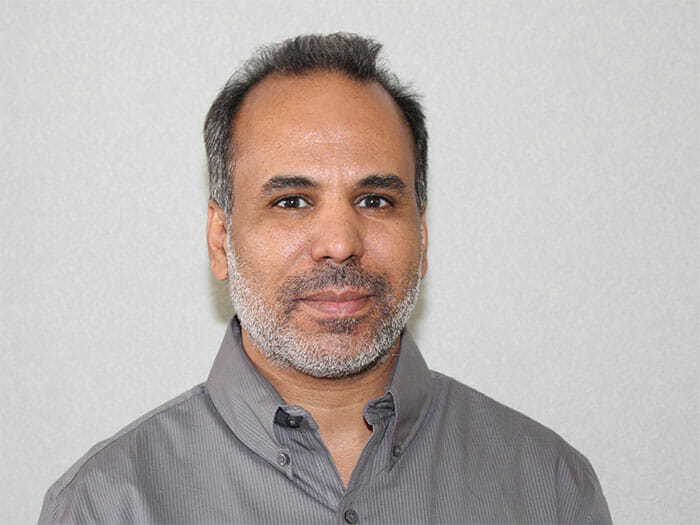
Dr. Zaghloul Ahmed
The past academic year has been exceptionally rewarding for Dr. Zaghloul Ahmed, who has earned four major grants for his work in treating mobility complications due to serious spinal cord injuries.
The grants, two awarded by the New York State Department of Health, one by PSC CUNY, and one by the National Institutes of Health (NIH) total nearly $850,000 toward Dr. Ahmed and his collaborator’s spinal cord injury research.
Dr. Ahmed’s research on spinal cord injuries focuses on using Trans-Spinal Direct Current Stimulation to alter the muscle tone in mice suffering from spasticity due to these injuries. According to Dr. Ahmed, the spasticity causes stiffness of the muscles affected by the nerve damage caused by spinal injuries. This stiffness can cause patients suffering from these injuries to have difficulty moving and going about their daily lives.
Dr. Ahmed’s project aims to discover what types of treatment can lead to long term relief in people who have suffered from spinal cord injuries or even from strokes.
The experiment tasks the researchers to run a very weak direct current through a mouse’s spinal cord suffering from spasticity in order to stimulate the corresponding nerve. What they have found is that depending on several factors such as current duration, intensity, direction and location, there is a significant decrease in muscle tone abnormality which results in an increase in motor movement.
Dr. Ahmed, an Associate Professor with the Department of Physical Therapy (DPT) with theSchool of Health Sciences at the College of Staten Island, commented “I am very happy and grateful that the government has given us this grant. We can now expand our work and get ready for the next application.”
The next step in the research, Dr. Ahmed hopes, will move the work from mice to clinical trials in humans though there are still a few factors that need to be clarified.
“We still need to investigate how long the treatment will be effective, what dosage, and how much current, exactly we need to pass through,” said Dr. Ahmed on the work that his lab is conducting.
“We always have one or two groups working on different levels of this project,” commented Dr. Ahmed on the fluidity of the program, adding that the physical therapy department currently has a system where each of the faculty gets a small group of students to work on their clinical research. There is currently one group of students working on mice and another group working on the human element of the project studying reflexes which will one day apply to Dr. Ahmed’s project once it enters clinical trials in people.
“Our physical therapy students [at CSI] are working very hard,” noted Dr. Ahmed, adding he has also engaged a group of high school students to work on the behavioral aspects of the project.
These grants awarded for Dr. Ahmed’s project, along with his research team’s dedication and hard work, will one day benefit those who have suffered spinal cord injuries and help them once again lead normal lives.
Dr. Zaghloul Ahmed was awarded the 2011 NYC BioAccelerate Prize For a Neural Stimulation System.
By Carlo Alaimo

Tuesday, January 26, 2016

Understanding the Electrical Pathways of the Nervous System via Trans-Spinal Stimulation Clinical Trials

November 17, 2015


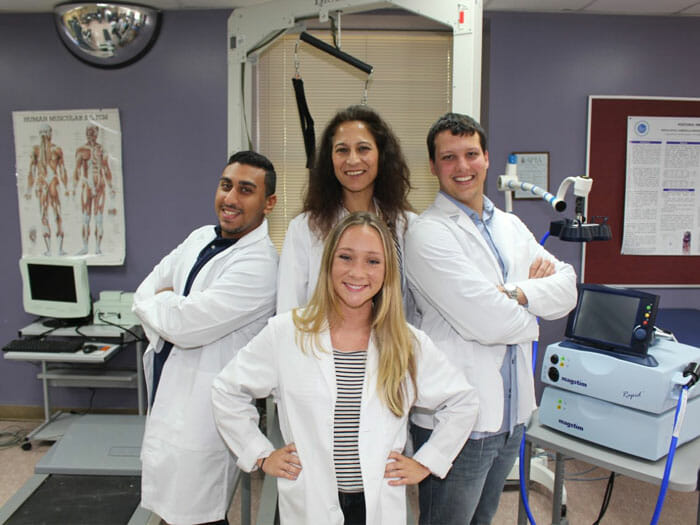
Dr. Knikou (top-center) and her DPT students work collaboratively towards a better understanding of human movement in health and disease.
Dr. Maria Knikou was recently awarded a $400,000 grant by the Craig H. Neilsen Foundation to develop strategies in treating people who suffer from serious spinal cord injuries, and bringing sensation and mobility back into their lives.
“People with spinal cord injuries have motor dysfunction that results in substantial social, personal, and economic costs,” said Dr. Knikou, a neurophysiologist and Professor of the Clinical Doctorate in Physical Therapy (DPT) program with the School of Health Sciences, explaining the impetus for her research. “This uncontrolled muscle spasticity and motor dysfunction can result in disabilities that significantly reduce quality of life.”
This grant will enable Dr. Knikou and her researchers to develop a stimulation protocol in order to, Dr. Knikou explains, “induce functional recovery” in people who are attempting to recover from moderate to serious spinal injury.
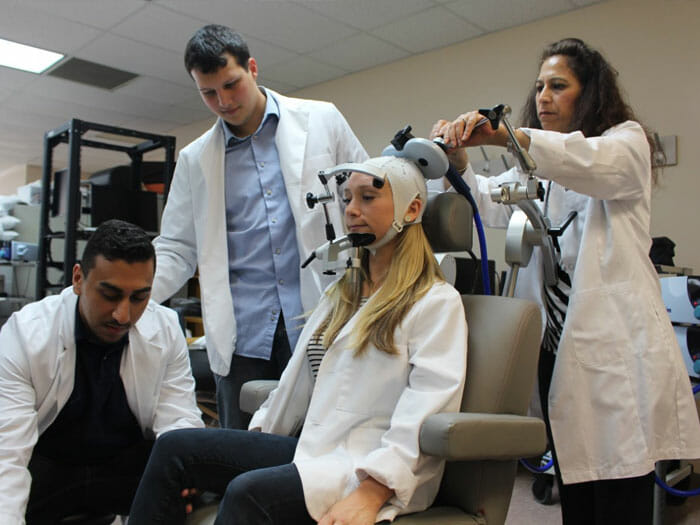
Research in action: non invasive transcranial magnetic stimulation assesses connections between the brain and leg muscles.
Dr. Knikou’s research on spinal cord injuries focuses on utilizing non-invasive trans-spinal stimulation of the spinal cord with constant or direct electrical current to strengthen the connections between the brain and spinal cord, thereby improving movement.
The two-year grant was awarded for Dr. Knikou’s project, titled, “Trans-spinal Stimulation to Increase Neuroplasticity and Recovery after SCI,” which seeks to test a new intervention to treat motor dysfunction of people suffering from spinal cord injuries.
Her lab uses Trans-Spinal Constant or Direct-Current Stimulation to alter the signals between the nerves and muscles in people suffering from spasticity due to injuries. According to Dr. Knikou, this spasticity causes stiffness of the muscles affected by the nerve damage caused by spinal injuries. This stiffness can cause patients suffering from these injuries to have difficulty moving and going about their daily lives. Dr. Knikou’s project aims to not only treat subjects who are undergoing the clinical trials but also to research more effective strategies in order to provide long-term treatment.
The treatments are non-invasive and require the subjects to receive 40-minute non-invasive Trans-Spinal Stimulations daily for three weeks. One of the machines used is called Trans-Cranial Magnetic Stimulation (TMS), which both acts as treatment for the subjects during the clinical trials as well as helps the researchers study the action potential of the stimulation being provided.
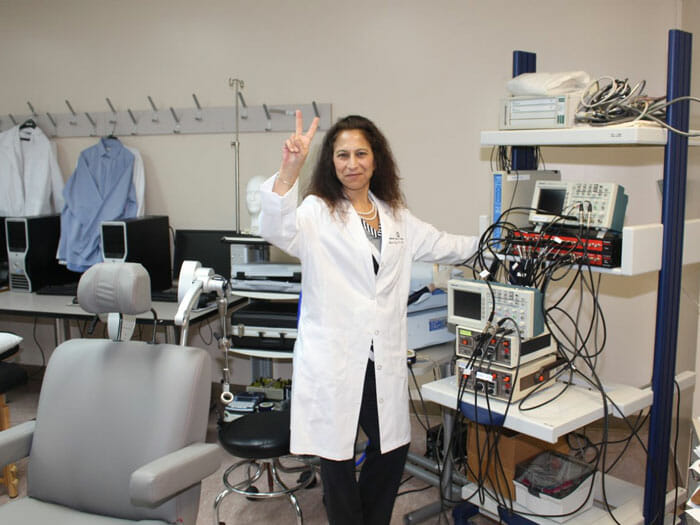
Dr. Knikou celebrates victory on understanding the function of the human nervous system via non-invasive electrophysiological methods.
Dr. Knikou elaborated on the methodology that her lab uses, saying “People with motor incomplete spinal cord injury will be randomized to receive trans-spinal stimulation with direct or constant current.” The researchers, many of whom are post-graduates working on their DPT degrees as well as CSI postdoctoral research fellows, also use an EEG machine to map the areas of the brain that are being stimulated in order to better understand which placement and intensity of the electrodes works best with each subject. “Results from the proposed project will provide for the first time evidence on a novel neuromodulation method that has the advantages of being noninvasive, cost-effective, and can be used in different clinical settings to improve motor function and decrease spasticity after spinal cord injury in humans,” Dr. Knikou concluded.
While the overall goal of these clinical trials is to provide relief to people currently suffering, it will also build novel and effective rehabilitation strategies.
Dr. Knikou remains passionate about training the next wave of physical therapy researchers, and she demonstrates this by tasking her lab’s doctoral and undergraduate students with assisting with the clinical trials in a very hands-on manner.
Speaking of her philosophy behind her delegation of her student’s responsibilities, Dr. Knikou says.  “I want them to not only be consumers but also creators of research.”
For more information about the Trans-Spinal Stimulation clinical trials, visitwww.csi.cuny.edu/schoolofhealthsciences.
By Carlo Alaimo & Ken Bach